

 By
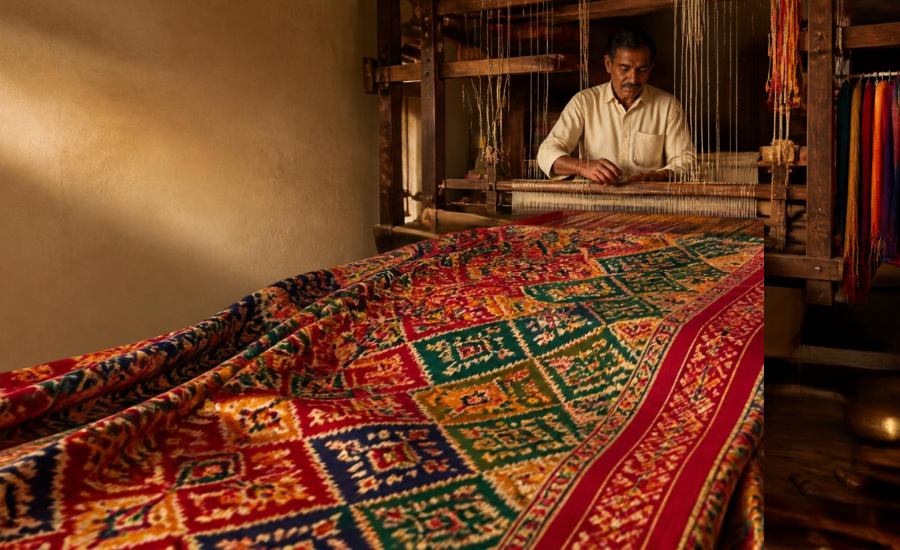
By Among India’s many exquisite handloom traditions, Patola sarees occupy a truly distinctive place. Known for their vibrant colours, intricate motifs, and exceptional precision, Patola is not simply a silk saree—it is the result of a highly demanding weaving process that can take months to complete.
At the heart of this remarkable craft lies double ikat, a technique that requires extraordinary patience, planning, and skill.
What Is Double Ikat?
Ikat is a traditional textile technique in which sections of yarn are carefully tied and dyed before being woven into fabric. In double ikat, this process is carried out on both the warp and weft threads.
This is what makes Patola particularly challenging.
The weaver must plan the entire design in advance and determine exactly where each section of thread needs to be tied and dyed. Once the yarns are prepared, the warp and weft are carefully aligned on the loom so that the colours meet at precisely the right points.
Even a slight misalignment can disrupt the pattern.
Unlike a design simply printed onto fabric, the motifs in Patola are essentially built into the structure of the textile itself.
Precision Behind Every Thread
The complexity of Patola becomes even more impressive when you consider the number of steps involved.
First, the design is carefully planned. The yarns are then divided into sections and tied to prevent certain areas from absorbing particular dyes. After dyeing, the threads are untied, repositioned, and often dyed again to create additional colours and details.
This process may be repeated several times before the yarn is ready for weaving.
When the dyed warp and weft finally come together, they create the intricate geometric and floral patterns associated with traditional Patola.
The weaver’s job at this stage is one of extraordinary precision. Every thread must interact correctly with the others to reveal the intended design.
Why Patola Takes So Long to Make
The elaborate preparation involved in double ikat means that creating a traditional Patola saree is a time-intensive process.
The complexity depends on the design, colours, and level of detail, but traditional Patola weaving can require extensive preparation before the actual weaving begins.
This is one reason authentic handcrafted Patola sarees are regarded as luxury textiles. Their value comes not only from the silk but also from the hours of skilled human labour invested in every piece.
Motifs That Tell a Story
Patola is also celebrated for its distinctive motifs. Traditional designs may feature parrots, elephants, flowers, dancing figures, geometric patterns, and other symbolic elements.
These motifs are arranged with remarkable symmetry, giving the saree its instantly recognisable appearance.
The vibrant colour combinations further enhance its visual appeal, making Patola suitable for festive occasions, weddings, and celebrations while retaining its connection to Gujarat’s rich textile heritage.
Patola vs. Other Silk Weaves
Many Indian silk sarees are known for specialised weaving traditions. A Banarasi saree, for example, is celebrated for its luxurious silk, intricate brocade, and shimmering zari work. Kanjeevaram sarees are renowned for their rich silk, distinctive borders, and traditional motifs.
Patola’s uniqueness lies elsewhere: the complexity of creating the design before and during the weaving process itself.
With double ikat, both sets of threads must be prepared and aligned to produce the final pattern. This makes the technique exceptionally demanding and gives the finished saree its characteristic depth and precision.
A Craft Worth Preserving
In today’s world of fast fashion and mass production, Patola represents a very different philosophy. Every saree reflects planning, patience, craftsmanship, and generations of textile knowledge.
The beauty of Patola is therefore not limited to its vibrant appearance. Look closely, and you are seeing the result of countless carefully calculated movements—from tying and dyeing individual threads to aligning them on the loom.
That is the true magic of double ikat.
A Patola saree is not merely woven into existence; its design is carefully engineered thread by thread. It is this extraordinary combination of artistry and technical precision that makes Patola one of India’s most complex and celebrated textile traditions.